Our Story

A portrait of Benjamin Walters in formal wear from circa 1700s, who was the first member of the Walters family to become a Master Weaver based in Spitalfields, London. millshop timeline / also in 300+10 book

1720

Stephen Walters & Sons can trace its origins to Benjamin Walters, who was the first member of the Walters family to become a Master Weaver based in Spitalfields, London. His son, Joseph I also went on to become a Master Weaver of the Worshipful Company of Weavers.

1772

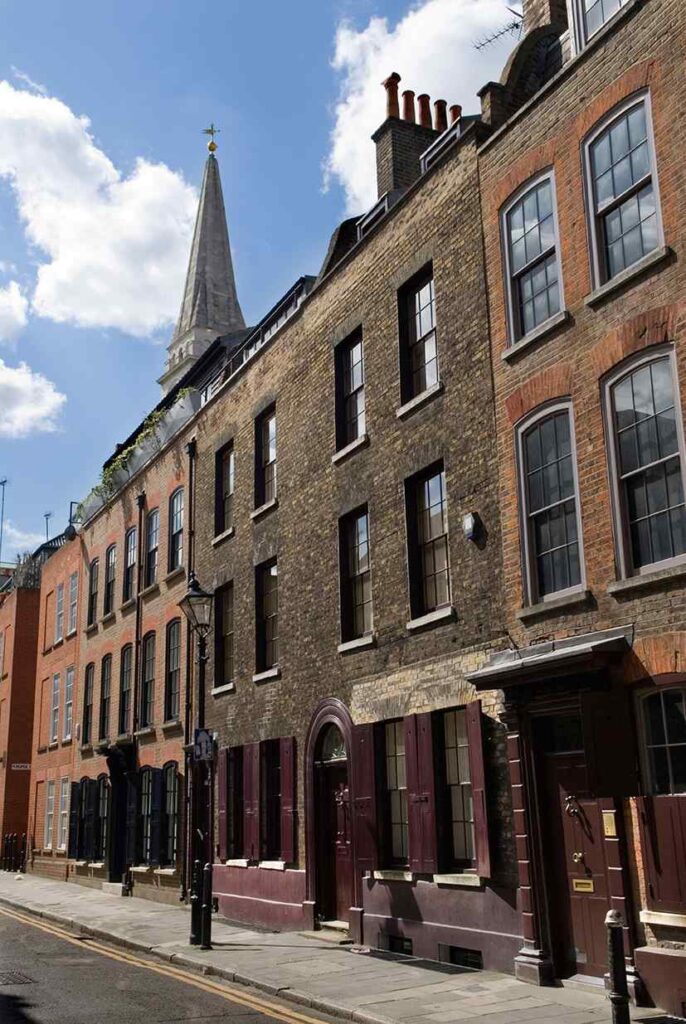
Joseph and his wife moved to 25 Wilkes Street, Spitalfields. Here, with his father and younger brother George, they produced draw loom fabrics for dresses. This is considered as the first Stephen Walters site.

Spitalfields London Uk. Georgian town houses. Wilkes Street London EC1. Spitalfields Christ Church spire in background.
300+10 book page 53 - black and white photograph of weavers and looms circa 1770

1770s

In 1773, the first Spitalfields Act introduced regulations on wages, increases on taxes and restrictions on apprentices for the silk industry. This resulted in weavers and yarn spinners moving out of London.

Early 1800s

The company expanded moving to Suffolk and Essex, benefiting from the weaving skills that were available due to the decline of the wool industry in these areas. It was here that power looms and new Jacquard technology were introduced.

Black and white photograph of female weavers in the 1800s dressed in white pinafores standing by hand weaving looms. 300 + 10 book page 45
silk weaving heritage - an image showing the Sudbury Silk Mills factory from the Sudbury Meadows behind the factory

1900

The factory at Sudbury Silk Mills was purchased, and weaving operations were consolidated there. The building, though much extended, remains the company’s headquarters to this day.

Mid 1900s

The company continued to prosper, weaving a wide variety of fabrics including Spunella for ladies’ dresses, facing fabrics for tuxedos and Repp stripes for neckwear. During the second world war the looms were recommissioned to weave silk for parachutes.

Black and white photograph of various persons looking a fabric on a weaving loom. 300+10 book page 57
A weaver standing by a loom looking at the light coloured fabric on the loom which is to be used for the lining of Queen Elizabeth II’s Coronation robe

1952

Stephen Walters was approached for a special royal commission, to weave the fabric for the lining of Queen Elizabeth II’s Coronation robe.

1964

After joining the business as the ninth generation, David Walters pioneered the next step by investing in new technology and introducing rapier jacquard looms.

Detailed image of yarn and drop wires on a weaving loom
Image of Prince Charles, Prince of Wales and Diana, Princess of Wales on their wedding day. The wedding dress made of Stephen Walters silk, designed by David and Elizabeth Emmanuel

1981

Stephen Walters wove the silk for Lady Diana Spencer’s wedding dress, famously designed by the Emanuels.

Late 1980s

The company continued to lead the way, switching from traditional punch card methods to new computer technology. Working hand in hand with software providers they developed a bespoke program, which enabled digital design archiving.

Image of a historic loom weaving card. 300 + 10 book page 41
Image of factory and staff taken to mark the 300 year anniversary

2020

Stephen Walters celebrated its 300th anniversary, making it the oldest silk weaving company in Great Britain

2023

The company became the first UK Textile Manufacturer to be awarded Oeko-Tex STeP accreditation, which certifies the manufacturing process for environmentally friendly and socially responsible production facilities.

Colourful Stephen Walters illustration showing Sustainability journey, from silk cocoon to silk yarn, dyeing the yarn cone, producing the silk fabric on looms, packaging and then leaving in a lorry to its final destination.
King's Award Sustainable Development 2025

2025

Stephen Walters was honoured with the King’s Award for Enterprise in Sustainable Development. It is the most prestigious business award in the UK and was awarded for their responsible manufacturing practices.

Today

The company is one of the leading producers of fabrics for the luxury fashion industry, supplying some of the world’s most prestigious brands.